On 4 December 2026 a consumer-finance lender reaches the confirmation gate on a two-app mobile programme. The decision is not React Native versus Flutter. It is whether to accept a supplier's fixed price built from a screen count. My question in that room: your own two versions of the baseline differ by 66 screens and 411 person-days, so what exactly is being bought, per screen?
What the evidence says
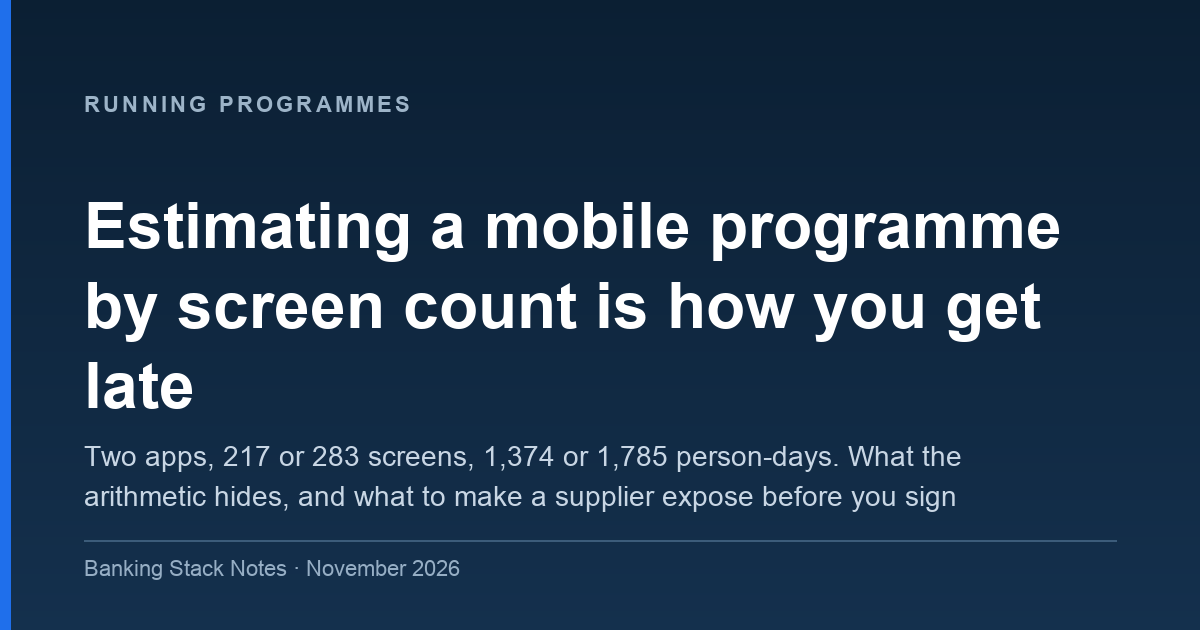
- The screens were never counted. One version of the anonymised baseline carries 217 screens and 1,374 person-days; a later one 283 and 1,785. Both mark the count as assumed; counting is the supplier's first-month work.
- Most of the work is not a screen. The scope names 14 links to systems that stay, 13 services across two backends (7 customer, 6 sales), 32 security requirements in 12 groups and 9 shared packages at 205 person-days. Tests are 34% of development effort; security 11%.
- The unit does not reproduce. A hand-written screen takes 2, 4 or 7 days by complexity; a carried-over screen 22% of that, a new screen with AI tools 55%. Applied to 88 new screens, the inputs imply about 7.3 days each — above the document's 7-day maximum.
- The AI assumption is the widest lever. The base case assumes a 45% saving on new screens; the client's own review of published measurements ranges from no gain to about 30% on single tasks.
- The options differ by a fifth, not a factor. Reuse 1,785; Flutter all-new 2,155 (+20.7%) on the same calendar; hybrid 2,305 (+29.1%); native 3,125 (+75.1%). Stated range 1,580–2,310.
- The dates carry conditions. Proposal 16 November 2026; confirmation gate 4 December 2026; contract by 3 February 2027 or first release slips from 25 November 2027 to 10 February 2028; design gate 26 March 2027 is the last date to change technology without rework. Float: three weeks.
The decision framework
Score the estimate, not the deck. Weights assume a regulated lender.
| # | Criterion | Weight | What "high" looks like |
|---|---|---|---|
| 1 | Productivity basis by screen class | 20% | Days per class bottom-up, reuse and new separated, AI gain measured rather than assumed |
| 2 | Proof of reuse and build rights | 15% | Build rights confirmed; eKYC vendor letter for the current framework and 16 KB pages |
| 3 | Integration ownership | 15% | All 14 links owned and dated; status events (about 19 person-days) and no-chip route (about 25) priced |
| 4 | Native layer risk | 15% | Named Swift and Kotlin engineers; chip reading on real devices by the design gate |
| 5 | Compliance evidence | 15% | 32 requirements mapped to evidence; Circular 77/2025; two penetration tests; AA and 5-second cold start tested |
| 6 | Calendar credibility | 10% | 1,785 person-days resourced inside the calendar, or own dates with reasoning; backends and database link dated |
| 7 | Run and exit | 10% | Run effort in person-days, fix times, keys and store accounts with the client |
Three checks sit in front of the scoring: the eKYC kit supports the current framework and the 16 KB page size; shielding covers the chosen code and the Circular 77/2025 checks; the client holds source code and build rights. Any failure prices the work at the Flutter effort of 2,155. Circular 09/2020 adds the same demands from the regulator's side: provider assessment, contract clauses, source-code handover, no production data in tests.
Options and trade-offs
| Option | Strength | Risk | Three-year cost shape |
|---|---|---|---|
| React Native reuse (1,785) | Smallest effort; one code base for two apps | Three unverified checks and a 45% AI assumption | Build-heavy in year one, then support; cheapest if the checks hold |
| Flutter, all new (2,155; +20.7%) | No dependence on existing code or build rights; same calendar | All 283 screens new; two skill pools to keep | A fifth more build; reuse question closed |
| Native (3,125; +75.1%) | Closest to platform, no bridge to defend | Two code bases, slowest to staff, largest test surface | Highest build and run: two release trains |
The stated range spans 41% of the base case — wider than the 20.7% gap between the leading options.
The numbers
No rates, prices, budget or reserve appear in the sources, so any money figure attached to this programme is somebody's assumption. What is quantified:
- Build: 1,374 or 1,785 person-days, against a stated range of 1,215–1,776 or 1,580–2,310. Client estimates, not quotes.
- Client side: 355 or 460 person-days, including a mobile technical lead and reviewers. One version counts 70 design-agency days.
- Excluded: two backends (13 services), the admin portal, the 14 links, platform capacity, data migration, legacy retirement, third-party licences, business-side effort.
- Run: the supplier must propose annual run effort in person-days; no figure is stated. An in-house alternative puts first release 7.1 months later at the same effort.
What I would do in 30 / 60 / 90 days
Next 30 days — to the 4 December 2026 gate
- Count screens by class before anyone prices them.
- Demand written evidence for the three checks: eKYC vendor letter, shielding documentation against Circular 77/2025, build rights.
- Ask for days per screen class, reuse versus new, with the productivity basis. Refuse a blended rate per screen.
Days 30 to 60 — to contract
- Decide 3 February 2027 deliberately: sign by then, or accept 10 February 2028 and rebuild the case.
- Take the two-stage contract: foundation stage 18 January to 26 March 2027 on time and materials with a ceiling, break right at the design gate; then fixed per release from 29 March 2027, paid on acceptance.
- Keep architecture, security, keys, store accounts and production access. A supplier holding the keys holds your release.
Days 60 to 90 — to the 26 March 2027 design gate
- Verify the three checks on real devices. After this gate, changing technology means rewriting the app code.
- Confirm the backends and database link have committed dates; the baseline calls this the largest dependency risk.
- Re-derive the per-release gates; they do not map onto the four public releases.
What I would not do
- Not price per screen. The count moved 30% between versions of the same document, and the effort moved with it.
- Not plan on a 45% AI saving when the same document's review finds no gain to 30% on single tasks.
- Not start build before the backends and the national database link are committed. That buys an app that cannot go live on its date.
- Not treat three weeks of float as slack, nor the Tet freeze from 20 December 2027 to 9 February 2028, itself an assumption.
For the non-technical sponsor
A mobile app is priced per screen but paid for in integration, security evidence and testing. Here the screen count moved by 30% between two versions of the same document, and the effort moved with it. Approve the estimate only when the supplier shows days per screen class, states its productivity basis, and proves the three technical checks by 26 March 2027.
Sources
- Anonymised scope and effort baseline, two versions, 217 and 283 screens (internal, no public URL).
- Team Topologies, team types and interaction modes, https://teamtopologies.com/key-concepts
- McKinsey, ING's agile transformation, on owning run, https://mckinsey.com
- Spotify Engineering, squad, tribe and chapter model, https://engineering.atspotify.com
- Reserve Bank of India, outsourcing directions (12 August 2022), https://www.rbi.org.in/Scripts/NotificationUser.aspx?Id=12378&Mode=0
Personal views. Client and employer details are anonymised. Figures are third-party estimates, not vendor quotes, and are dated November 2026.
Comments
Join the discussionNo comments yet. Be the first to comment.